
‘This was [Harry Lowery’s] first time to the Soviet Union and it was pure joy to watch the buoyant enthusiasm with which he added Moscow, Leningrad and Tashkent to his bag.’
- Mrs G. R. Barrell, 1967.
Dr Harry Lowery, M.Ed., D.Sc., Ph.D., F.Inst.P., was appointed Principal of the South-West Essex Technical College and School of Art in October 1937, one year before the College was to open. He would continue to guide the College until his retirement at the end of the 1962-1963 academic year, making him the longest-serving Principal at the College over a period of almost 26 years.
Harry Lowery was born in 1896 in Hensingham, Cumberland to Henry and Annie Lowery. His primary education was at Montreal School, Cleator Moor. He then attended the County Secondary School, Whitehaven, before studying at universities in London, Leeds and Manchester.[1]
Dr Lowery was a man of many interests and talents. His primary profession was that of a physicist, which he brought into his secondary profession as an educationalist, but his true passion was as a musician. Mrs G. R. Barrell, writing after Dr Lowery’s passing, indicates how all his passions aligned:
‘It was this marriage of science and art which fitted him to become an international authority on musical acoustics. His interest in education was abiding and he devoted much of his spare time to Trinity College of Music, of which he was a governor, and to the College of Preceptors, of which he was a vice-president.’[2]
Dr Lowery’s instrument of choice was the organ. He was Organist to the Manchester College of Technology where he ‘designed and supervised the installation of a three-manual concert organ’.[3] Lowery gave regular recitals on this instrument and was broadcast to the North Regional BBC as well as empire transmissions. He was also involved in many organisations, being an honorary member of the Incorporated Society of Musicians, the American Guild of Organists, and the President of the London Society of Organists.[1] He also published at least two books on music ‘The Background of Music’ and ‘A Guide to Musical Acoustics’.
As a physicist, Dr Lowery’s interests centred around ‘Applied Optics and Technical Acoustics, in connection with which he...published over sixty papers’. His research and designs found many theoretical and practical applications, one significant example being a road danger lamp of which thousands were produced and installed around the country.[3]
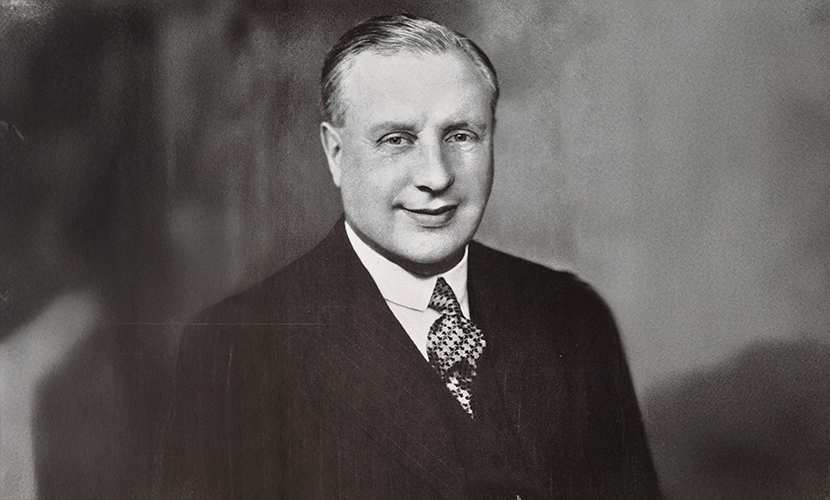
Dr Lowery’s career in education would see him work across many educational institutions. He started his career in secondary schools as Science Master over a period of six years before moving into the position of Assistant Lecturer in Physics at the University of Manchester in 1921-1925 under the direction of Nobel Prize winner, William Lawrence Bragg (later Sir Lawrence Bragg). After a period at Bradford and Huddersfield Technical Colleges, Dr Lowery returned to the University of Manchester in 1928 where he spent a further eight years as Head of Department of Pure and Applied Physics in the world-famous College of Technology.[1]
His first role as Principal came at the North West Polytechnic in Kentish Town until he took up his position of Principal at the South-West Essex Technical College and school of Art in 1937.
Lowery was a well-travelled man, often visiting other countries to learn more about alternative education systems and music. In 1961 he led a two-week delegation to the USSR on behalf of the College of Preceptors to study the education system. He also published a small book, ‘Some Aspects of Education in the U.S.A.’, after a trip to the country in the summer of 1948.
Mrs G. R. Barrell accompanied Dr Lowery on the delegation to the USSR. She stated that Harry Lowery will be remembered by those who knew him not as a great scientist or musician but as a ‘great man’ who was ‘uncomplicated’ and whose outstanding quality was ‘humility’. This is backed up in a letter by Lauren B. Sykes, Organist from Portland, Oregon, when he acknowledged the passing of Dr Harry Lowery:
‘Several years ago it was our good fortune to sit in [Dr Lowery’s] classes on acoustics at Trinity College. He struck me as being extremely well informed on his subject as well as being a kind and gentle person’.
Dr Harry Lowery died in 1967 after a distinguished career across three major fields: physics, education and music. He was cremated at Golders Green Crematorium[4] with a Memoriam held at The Church of the Holy Sepulchre, Holborn Viaduct, London on 29th November 1967, by The Reverend Canon R. Tydeman, M.A..
Mrs G. R. Barrell ended her obituary saying:
‘For those who knew [Harry Lowery] there remains a gap which is greater than can be filled by a single man.’[2]
References
Who’s Who 1952 - An Annual Biographical Dictionary with Which is Incorporated “Men and Women of the Time”, London: Adam & Charles Black, 1952, p. 1752.
Barrell, Mrs G. R., “Dr. H. Lowery,” The Times, 6 October 1967.
“Dr. Lowery,” Unknown magazine origin, presumed produced within the College as an interest piece., 1938.
West Essex Gazette, “Dr. Lowery Dies,” West Essex Gazette, 6 October 1967.
Researched and written by Thomas Barden


