
‘The task of building up a skilled, healthy and intelligent body of workers is equally important for war or peace. No victory, however complete, will enable us to survive as a great power if we lack it. And if as we all hope, there is no war, then the normal rivalries that always existed between nations will continue, and it will be by this standard that both nations and their systems of government will rightly be judged.’
- Herbrand Sackville, Rt. Hon. The Earl De La Warr, 1939.
During 1939 the political situation in Europe was becoming increasingly unstable. After Germany occupied Prague in March, Prime Minister Neville Chamberlain declared:
‘In the event of any action which clearly threatened Polish independence....His Majesty’s Government would feel themselves bound at once to lend the Polish Government all support in their power.’[1]
So it was that less than a year after Prime Minister Chamberlain came back from Munich declaring ‘peace for our time’ the United Kingdom, alongside France, declared war on Germany in response to the invasion of Poland on 1st September 1939.
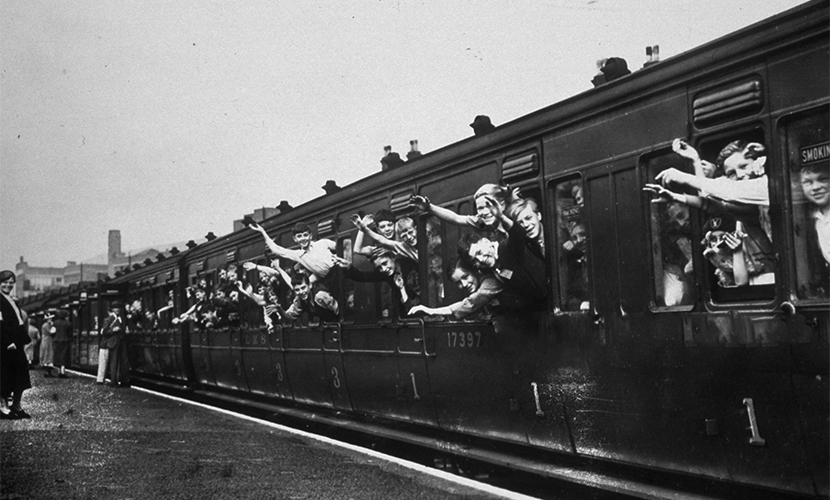
It was no secret that war was on the horizon. When the College broke up on 26th July for the summer holidays staff had been requested to leave holiday addresses so they could be recalled at any notice. This recall was enacted and by 26th August all staff had arrived at the College to prepare and send letters of instruction to parents regarding evacuation, reliving the events of one year earlier. All preparations were made including armlets for group leaders and a large banner with the name of the school emblazoned on it.[2]
The instructions were for school children to come to the College prepared for an evacuation. Every day from 28th August children were to bring a suitcase with spare clothes, a gas mask and food for a possible trip to a yet unknown part of the country. Finally, amid rising suspense, the order to begin evacuation was received on Thursday 31st August 1939. The following day a procession of students and staff (armed with a large pole banner with the College name) left the College down Forest Road and Shernhall Street for the station. They would be leaving for Kettering.[2]
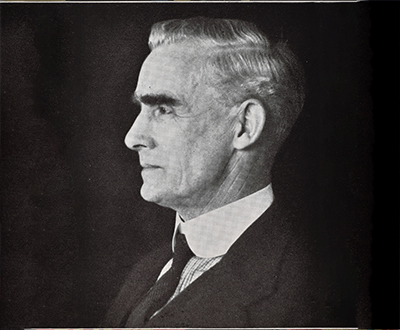
Principal Lowery reported on the day schools which were under the care of Miss Hall and Mr Wilkinson:
‘Thanks to the facilities placed at their disposal by Mr Scott, Headmaster of the Grammar School, and Mr Russell, Headmaster of the Central School, they were able to carry out first-class educational work, and obtained many successes in technical and commercial examinations.’[3]
Not every day school student was evacuated, those who stayed were transferred from the College campus to the two former buildings on Hoe Street.
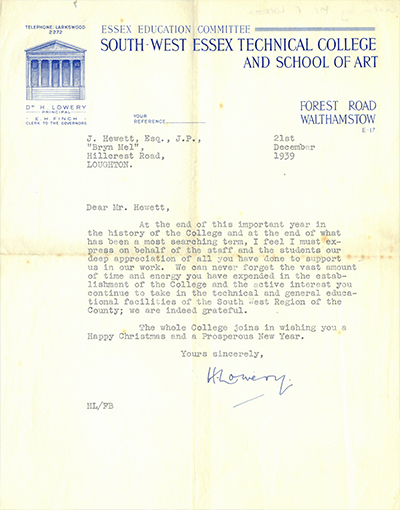
To round off 1939, Principal Lowery wrote to Mr J. Hewett:
‘At the end of this important year in the history of the College and at the end of what has been a most searching term, I feel I must express on behalf of the staff and the students our deep appreciation of all you have done to support us in our work. We can never forget the vast amount of time and energy you have expended in the establishment of the College and the active interest you continue to take in the technical and general educational facilities of the South West Region of the County; we are indeed grateful. The whole College joins in wishing you a Happy Christmas and a Prosperous New Year.’
References
What’s the Context?, “What’s the Context? 31 March 1939: the British Guarantee to Poland,” 28 March 2019. [Online]. Available: https://history.blog.gov.uk/2019/03/28/whats-the-context-31-march-1939-the-british-guarantee-to-poland/. [Accessed 14 July 2023].
W. R. Bray, The Country Should be Grateful - The War-time History of the South-West Essex Technical College and School of Art, London: The Walthamstow Press Ltd, 1947.
H. Lowery, “Day School for Boys and Day School for Girls,” in South-West Essex Technical College and School of Art Annual Report Session 1940-41, London, 1941.
Researched and written by Thomas Barden


